A light emitting diode is a diode that gives off visible light when forward biased.
Working Principle
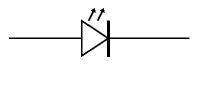 |
| Electronic Symbol |
When light emitting diode are forward biased the electrons from the n type material cross the pn junction and recombine with holes in the p-type material.Recall that these free electrons are in the conduction band at a higher energy level than the holes in the valance band.When recombination take place, the recombining electrons release energy in the form of heat and light.
In the Germanium and silicon diodes, almost the entire energy is gives up in the form of heat and emitted light is insignificant.However in materials like gallium arsenide, the number of photons of light energy is sufficient to produce quite intense visible light.
LED Voltage and Current
The forward voltage rating of most LEDs is from 1V to 3V and forward current rating range from 20mA to 100mA.In order that current through the LED does not exceed the safe, a resistor Rs is connected in series.
The voltage input is Vs and voltage accross LED is Vd
Then voltage accress Rs=Vs-Vd
Circuit current If=(Vs-Vd)/Rs
Application of LED
 |
| LED as power indicator |
As Power Indicator: A LED can be used whenever the power is on or off.The figure below shows the simple use of led in the power indicator.When the switch S is closed, power is applied to the load.At the same time current also flow through the LED which lights, indicate the power is on.
 |
| LED used in seven segment display |
|
|
Seven Segment Display: LEDs are also grouped to from seven segment display.The figure below shows the front of seven segment display.If a particular LED is forward biased it will provide a bar of light.By forward biasing various combinations of seven LEDs, it's possible to display any number between 0 to 9.
"
Do not use LED in Parallel"


